
From races to racer sponsorships to product companies to media, today’s running world seems dominated by the interests of large corporate entities, each working together to dominate the spotlight, and in so doing leaving little attention or money for the local race, racer, or product company. Perhaps it’s time to redirect the collective gaze from the big and global to the small and local, and in so doing broaden the number of opportunities for the badass regional race, runner, and business.
Running, Inc.
First, let’s look at racing, which in recent years has become dominated by a handful of huge races located across the globe. These races, with their pomp, prestige, and crowds, are surely fun to participate in, but they likely direct attention and money from regional races. These big races also make racing seem like a far more expensive, rarefied event than it needs to be —one necessitating difficult entry processes, large race entry fees, and usually airfare and accommodations in expensive locations (we won’t even delve into the environmental implications of all of this). Consider that the New York City Marathon only admitted 2-3 percent of people who applied to pay $315 to enter this year’s edition, according to Runner’s World. Given the marathon admits over 55,000 racers, that means there were around 1.8 million applicants. In the ultra world, the popular Western States Endurance Run (WSER) 100 miler admits a tiny elite field who must get tops spots in the extremely competitive Golden Ticket races held around the world to receive entry; the remaining entrants get in through a lottery with a 3 percent acceptance rate, per iRunFar. These two races are hardly outliers in their difficult entry processes. Other, big races that are becoming increasingly difficult to enter are the Boston, Chicago, and London Marathons on the road, and Leadville 100, Hardrock 100, UTMB, and CCC on the trail. In some cases, like Boston and WSER, the difficulty of gaining entry is merit-based —i.e. entrants must meet a stringent performance standard —but the enormous number of entries means the performance standard becomes absurdly high. More often though, not gaining race entry is a matter of too many people wanting a limited number of bibs. This growing popularity is a fairly recent phenomenon and seems as much, or more driven by social media-FOMO than an earnest desire to compete in these races.
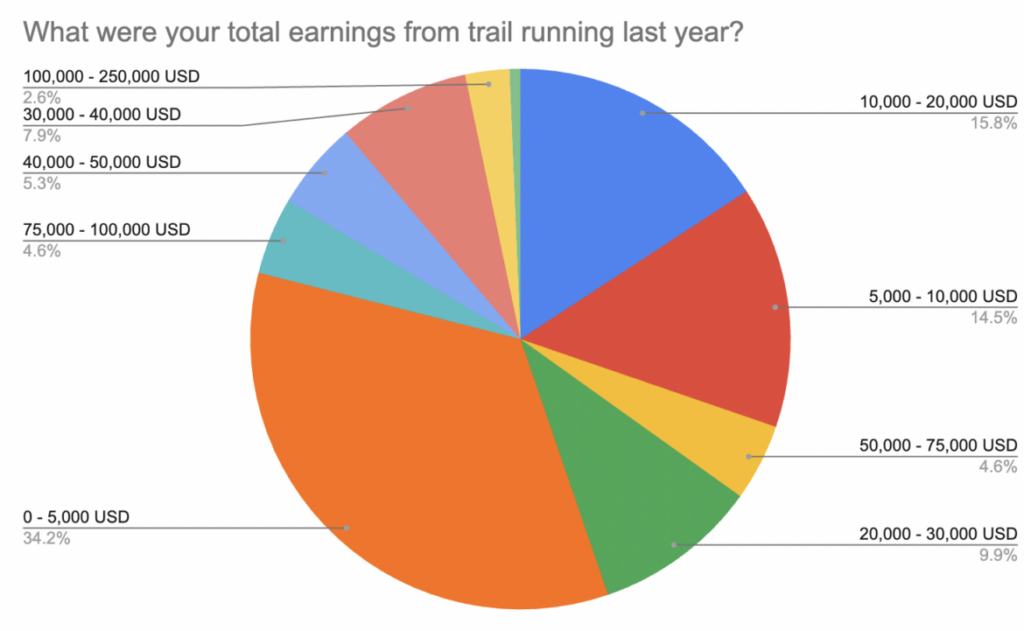
The growth in popularity of big races is directly related with the growing focus on a small pool of elite racers. Because the aforementioned races get such a disproportionate amount of attention relative to smaller, regional races, and because there’s a limited number of runners who can win or podium at the big races, sponsors are less interested in backing racers who aren’t winning or podiuming at the big races. If you’re not top 10 at NYC, Boston, or Chicago marathons (and sometimes even when you are), if you’re not podiuming at the World Championship series, Diamond League, or other major track events; if you’re not top-5 at Leadville, Western States, or UTMB, if you don’t have over 1M Instagram or YouTube followers —if you don’t tick these boxes, you probably need a day-job, despite being a world class athlete, despite the profound level of time and dedication it takes to even enter the field of any of the above races. A couple years ago, Ultrarunning Magazine verified this economic reality with a survey asking professional trail runners how much money they made; about 50 percent made less than $20,000 a year, and most of those (34 percent of all respondents) made less than $5,000. Apparently, the same is true about road running, according to Runner’s World.
Then there are the brands. Needless to say, most running product companies, especially shoe manufacturers, are owned by large corporations. Nike and Adidas have long been publicly traded companies, but many other shoe companies are subsidiaries of large corporations: Hoka and Deckers, Brooks and Berkshire Hathaway, Altra and VF Corporation, etc. A strong argument can be made that this big-business structure benefits runners, since the economies of scale these behemoths bring to R&D, manufacturing, and distribution increases innovation and decreases prices. The issue is the economic and marketing resources the big guys have —dominating gear reviews and ads, race and racer sponsorship, and so forth — leaves little airtime for upstart manufacturers and the potential disruption they could bring to the marketplace.
Finally, there’s running media, which often maintains an echo chamber of big race, racer, and brand boosterism. Though the digitization of media has led to a host of small-scale running media —mostly gear-focused ones like Believe in the Run —running’s main editorial engines are subsidiaries of big corporations like Outside Inc. (Outside, RUN, Women’s Runner), Hearst (Runner’s World), and, one arguably legacy newspapers like the New York Times and Washington Post, which increasingly publish pieces about running as the sport’s popularity grows. Because the content from these big outlets is targeting broad, often international audiences, there’s less room for covering regional races, racers, or brands. Further, the privileged relationship big media has with the big races and brands —relationships fueled by ad dollars and PR support —reinforces the primacy of those races and brands to the exclusion of smaller-scale, regional stuff. Lastly, these larger media outfits tend to be beholden to revenue-focused investor interests, replacing niche and long-form content with search engine optimized stuff like product reviews, news about top races and racers, listicle training and nutrition advice, and running-related travel pieces.
Re-localizing Running
Baseball flourished in America throughout the late 19th and early 20th century, with innumerable leagues and teams cropping up across the country. Without radio, television, or digital media, following and watching sports was inherently a local affair, as one had to attend a game to watch a game. It was also affordable, since ticket revenue, not media or merchandise rights, was the only source of revenue. If local audiences couldn’t afford to attend a game, there was no revenue. Star players were not multimillionaires with entourages, but normal folks you might know or see on the street. These players didn’t make a lot of money, and many, if not most, had off-season jobs. But during the season, many were able to travel and eke out a living playing the sport they loved.
With the advent of radio, TV, and eventually the internet, the focus shifted from watching a region’s best players in-person to watching the world’s best from wherever you might be. Media coverage shifted from local newspapers to huge media conglomerates. Sponsors shifted from local companies to global ones. Today’s professional sports landscape —be it baseball, football, cycling, running, etc. —has become a showcase of global genetic outliers playing on the world’s biggest stages. This shift has resulted in amazing athletic achievements, but it has also diminished the importance of local athletes, who may not field as well as Aaron Judge or run like Eliud Kipchoge, but are still exciting and inspirational to follow and maybe even get to know.
Most of us don’t even need to run marathons or ultras, distances that seem to be designed to justify big entry fees and produce an inordinate number of “oh yeah, I did some marathons/ultras years ago but got injured and stopped running” type of runners.
We humans have a limited amount of attention and money at our disposal. In the context of the running, if our attention and money is gobbled up by a handful of big races, runners, and brands, there’s inherently less of these things for their smaller-scale equivalents. This is a shame. Most of us—this back-of-the-mid-pack author included—have no reason to compete with the world’s best. Heck, most of us don’t need to run marathons or ultras, distances that seem to be designed to justify big entry fees and produce an inordinate number of “oh yeah, I did some marathons/ultras years ago but got injured and stopped running” type of runners. Local 5K, 10K, and sub-ultra trail races are awesome, and most of us can have amazing moments and find some of the most inspirational runners in our figurative backyards.* We should be celebrating these local races and racers, which is exactly what this site is dedicated to.
*Disclosure: my best running shoes were not made by local shoemakers.
Leave a Reply