
Most of my past running races were in New York City. Despite the city’s deserved reputation for ceaseless hustle and bustle, racing there was great. On any given weekend, the city hosted at least one big, well-organized race. New York Road Runners (NYRR) was the biggest race organizer, and as a NYRR member, you could register for 5 and 10ks for about $25 (c. 2019), which included some useful piece of kit like a tech shirt or gloves (half and full marathons cost more, but were far less frequent). There were other organizers as well. A community-organized race series around Prospect Park, blocks from where I lived, set racers back $35 —for seven races! Getting to most races was usually a matter of hopping on the subway, or sometimes a short run. At my peak, I raced 2-3 times a month, and came to expect racing as an affordable, low logistic affair.
Fast forward to my current hometown, Boulder, Colorado. Boulder is undoubtedly a global running Mecca, with many of the world’s top runners and absurdly fast and fit non-pros, calling the ~120,000 person town their home. Boulder has a bounty of attributes that make it an amazing place to run: high altitude, great weather, and a variety of terrain, including a world-class trail network. What it doesn’t have is a lot of accessible races.
To be fair, Boulder will never enjoy NYC’s economies of scale because of its much smaller population. And there area handful of relatively affordable races, organized by Boulder Road Runners, Dash N Dine, and Team Boulder. There are also parkruns 5Ks every Saturday, which are free, albeit not chipped or on a closed course. These exceptions aside, the bulk of races in the Boulder and Denver area are expensive, with most 5Ks I’ve seen costing a minimum of $40, and often a lot more. The cheapest bib for the 50,000 person Bolder Boulder 10K is $64, which goes up nearer racetime. Trail races are usually a minimum of $100, and way more for ultras. There are essentially no races that don’t require a car to get to besides the aforementioned mile and track races. Most of my friends only race a handful of times a year, usually at remote ultras or big marathons like Boston —all of which require considerable sums of money and logistical considerations.
I get it. Organizing a race is hard, requiring a lot of time and energy when you lack NYC’s systematized race organization. A couple Boulder race organizers I know must jump through a million permitting hoops to secure a race route. The high entry fees reflect all of this. And the greater Boulder-Denver metro area, like most American metros, is sprawling and car-centric, so driving everywhere is accepted as the norm. The high entry fees and logistics of getting to the startline are why locals only have a handful of races on their calendars. It’s a bummer. It’s a bummer that racing is so expensive and complicated. It’s a bummer there aren’t more informal opportunities to test your mettle against other local runners on local routes. It’s a bummer that racing is such a special affair, versus something a runner of all stripes and budgets can do throughout the year.
Unsanctioned Racing
Before I left NYC, “unsanctioned races” became a thing. These races were partly a response to the institutional vibes of big races like NYRR, which, though affordable and accessible, were invariably crowded and a bit too normcore for some. Unsanctioned races, as the name suggests, lack the blessing of city bureaucrats. They are not on closed courses, and sometimes they don’t have a course at all, requiring racers to hit checkpoints in with whatever route they think speediest. They often require insider info , e.g. being invited to a Signal chat group that announced race details the day-of. These races usually run late at night and involve a lot of Instagram-friendly shenanigans of questionable sanity and safety like sprinting across busy intersections.
Again, Boulder lacks the population density to get fields of 300 runners out for a midnight half marathon, but because of our bounty of fast folks and awesome routes, it seems like the running community could support some sort of unofficial competition. While I haven’t fully explored organizing an unsanctioned race, a time trial I organized last November points to the potential of unsanctioned racing in Boulder.
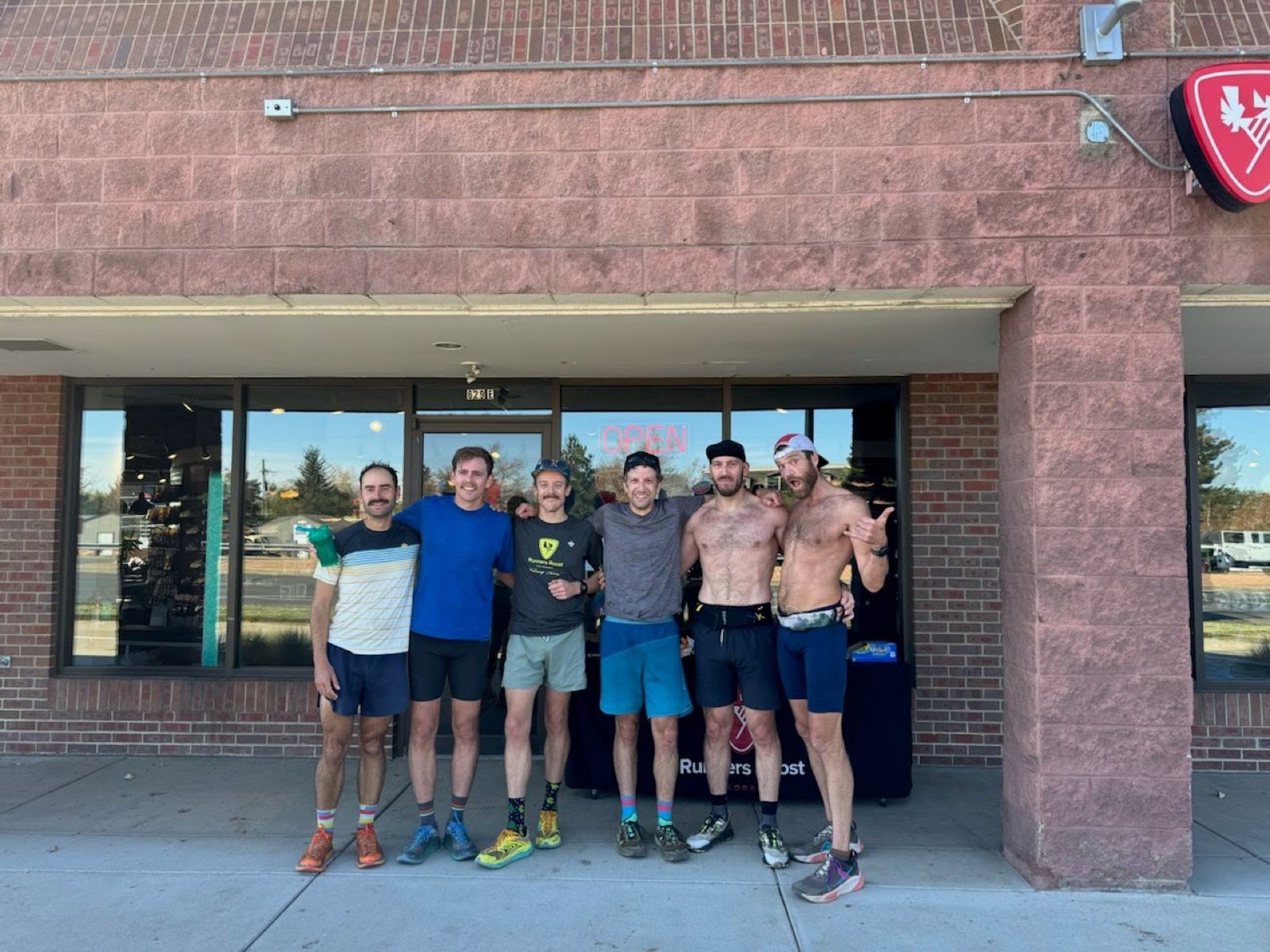
Some background: me and a handful of runners have been attending a weekly group trail run at a local shop, Runners Roost, for the last four-plus years. The route is the same each week, and though we occasionally run parts of it fast, the pace is typically conversational and there are set stops where we regroup. I wondered, “what would it be like if we ran this same route all-out like a race?”
Early last November, some of this core group met up for a time trial of the route. The time trial lacked typical race characteristics: there were no entry fees, the course wasn’t closed, no permits were filed with the city, there was not a big field. But it sure felt like a race.
We all took off at basically the same time and quickly strung out based on our paces. Even though we didn’t benefit from chasing or being chased by fellow runners like a large race, we managed to run at our limits, as attested by our post-race reports. Even at large races, I’ve found the main person I’m competing against is me.
Based on the Type 2 fun we had, I organized another TT in December, but had to call it off due to snow and single digit temps. I’m working on organizing a follow-up in March, and considering a prize structure where the winner would be whoever increased their PR by the biggest margin, not who ran the fastest time. It’s a work in progress.
These races need not replace bigger races. In fact, they can provide fun, informal tune-up races in the intervals between those races.
The biggest takeaway from the TT is that racing does not need to be expensive, remote, or filled with a bunch of strangers to be competitive, fun, or meaningful. On the contrary, the fact the route was one I’ve run hundreds of times with the same people I was competing with made it much more meaningful.
Leave a Reply to The Industrial Running Complex – The Run HomeCancel reply